
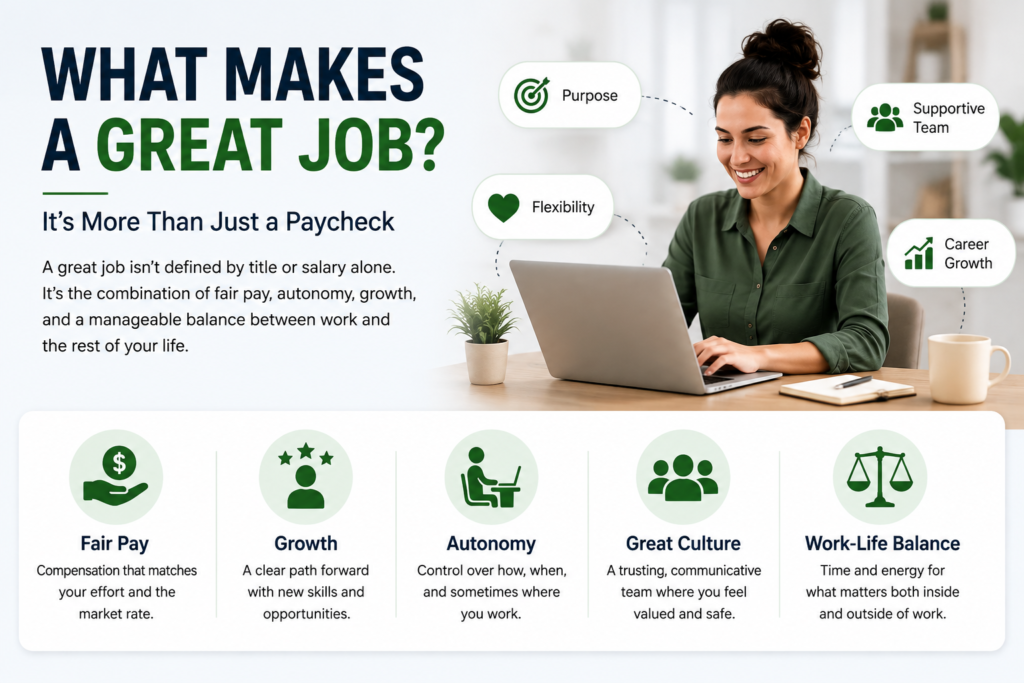
Searching for a great job? See what truly matters—fair pay, growth, and flexibility—plus how to actually land part-time remote roles. Find out now.
What Makes a Great Job? A Real-World Guide to Finding Work You’ll Actually Love
Most “great job” advice reads like it was written by someone who’s never had to choose between a longer commute and a better paycheck, or between flexibility and full benefits. This guide skips the platitudes. It breaks down what actually separates a great job from a job you tolerate, how part-time and remote roles fit into that picture, and how to go from “I need something better” to an actual offer letter.
Key Takeaways
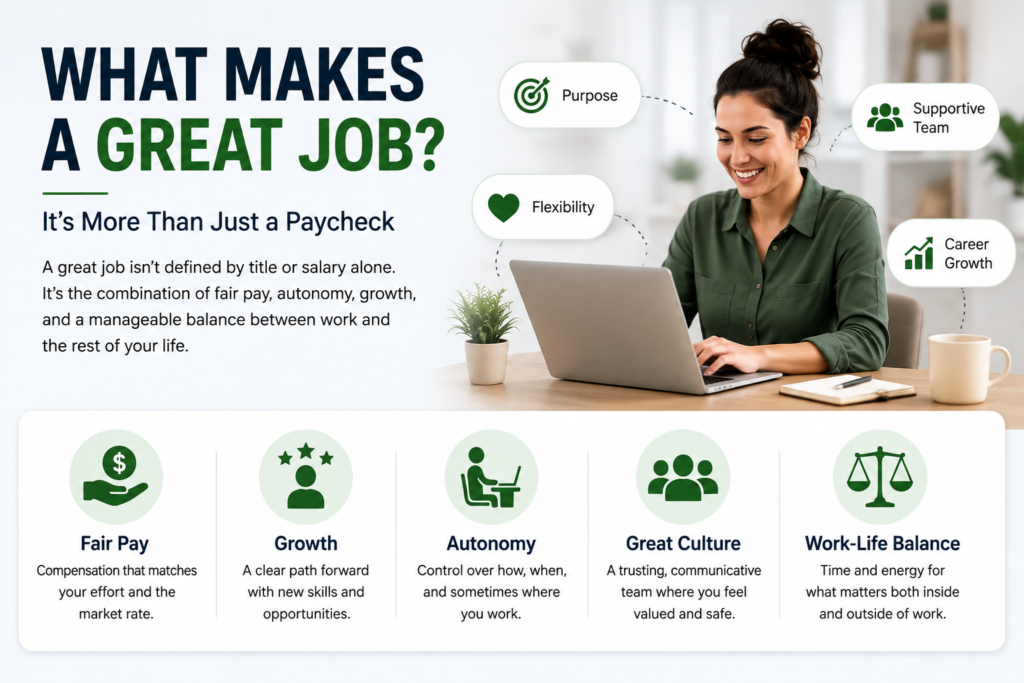
- A great job isn’t defined by title or salary alone — it’s the combination of fair pay, autonomy, growth, and a manageable relationship between work and the rest of your life.
- Part-time remote jobs have become one of the fastest-growing categories of work, and they’re not just for parents or students anymore — they’re a deliberate career strategy for a lot of people.
- Searching “part time jobs near me” works best when you pair local job boards with direct employer career pages, not just one big aggregator.
- Well-known regional employers, such as retail chain Ocean State Job Lot, post part-time store and warehouse roles directly on their own careers hub — a good reminder to check a company’s site, not just search engines.
- The strongest job search combines online applications with in-person visibility, especially for local, part-time, and hourly roles.
What Does “A Great Job” Actually Mean?
Ask ten people what makes a job great and you’ll get ten different answers — pay, flexibility, purpose, a good manager. Research on job satisfaction tends to converge on a smaller set of factors that show up again and again, regardless of industry:
- Fair, transparent compensation — not necessarily the highest number, but pay that matches the effort and market rate.
- Autonomy — control over how, when, and sometimes where the work gets done.
- Growth — a visible path forward, whether that’s a promotion, new skills, or more responsibility.
- Psychological safety — feeling like you can raise a concern or make a mistake without it costing you your job.
- Manageable workload — enough demand to stay engaged, not so much that it burns you out.
Notice that “prestige” and “big-name company” aren’t on that list. A great job is really a great fit — the right combination of these factors for where you are in your life right now.
The Difference Between a Good Job and a Great Job
| Factor | Good Job | Great Job |
| Pay | Meets your basic needs | Feels fair relative to your contribution and the market |
| Schedule | Fixed, little flexibility | Predictable, with room to adjust when life happens |
| Growth | Occasional review, no clear path | Regular feedback and a visible next step |
| Culture | Tolerable, low conflict | Trusting, communicative, low turnover |
| Control | Told what and how to do things | Given outcomes to hit, trusted with the “how” |
Doing a Great Job vs. Having a Great Job
There’s a second meaning worth addressing directly: people also search this phrase wanting to know how to do great work — how to actually perform at a level that gets noticed, promoted, or referred. A few things tend to separate people who are seen as doing a great job from everyone else doing “fine”:
- They over-communicate progress, especially on remote or asynchronous teams where no one can see them working.
- They finish the unglamorous 20% of a task — documentation, follow-up, handoff — that most people skip.
- They ask better questions early, instead of guessing and redoing work later.
- They manage expectations proactively, flagging risk before it becomes a missed deadline.
Both meanings — a great job to work at, and doing a great job once you’re there — matter more together than either does alone. A great employer makes it easier to do great work; doing great work is also how you earn your way into a great job in the first place.
The Rise of Part-Time Remote Jobs
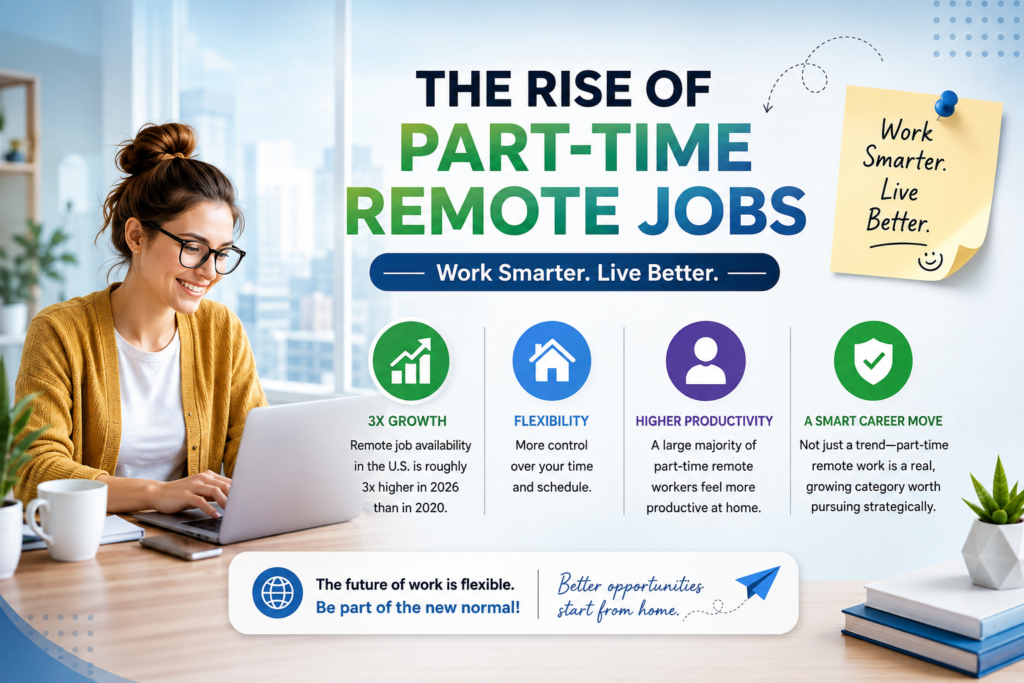
However, all things aren’t so well in remote world as well – some companies have tightened their return to office policies in 2026, and remote only vacancies have become less available in some sectors. Thus, the conclusion is not that remote work is guaranteed but rather that part-time remote work is actually available.
Who Part-Time Remote Jobs Actually Work For
- Parents and caregivers who need control over their hours without stepping fully out of the workforce.
- Students balancing coursework with income.
- Career changers testing a new field before committing full-time.
- Retirees or semi-retirees who want income and structure without a 40-hour week.
- People managing a health condition or disability that makes a rigid, in-office schedule difficult.
- Anyone building a second income stream alongside a primary job or business.
Pros and Cons of Part-Time Remote Work
| Pros | Cons |
| Control over hours and location | Often no employer-sponsored health benefits |
| No commute, more time flexibility | Can feel isolating without deliberate effort to connect |
| Easier to combine with caregiving, school, or a second job | Income is lower and sometimes less predictable |
| Access to jobs outside your immediate city | More competition per posting than local, in-person roles |
| Good testing ground for a career pivot | Requires strong self-management and communication |
How to Actually Land a Part-Time Remote Job
- Filter by “part-time” and “remote” separately, not as one combined search term — many job boards treat them as two filters, and combining them in the search bar misses listings.
- Lead with outcomes on your resume, not just responsibilities. Remote hiring managers can’t observe your work ethic in person, so the resume has to prove it.
- Over-index on communication skills in interviews. Remote and part-time roles live or die on how well someone updates their manager without being asked.
- Check company career pages directly, not just aggregators — many remote-friendly employers post part-time roles on their own site before (or instead of) syndicating them.
- Be upfront about your availability. Vague answers about hours are one of the fastest ways to lose a part-time offer to someone who’s specific.
Finding “Part Time Jobs Near Me”: A Practical Local Search Strategy
If your priority is in-person, hourly, or hybrid work close to home, the search behaves differently than a remote job hunt. A few things actually move the needle:
- Use your phone’s location settings when searching “part time jobs near me” so results reflect your actual radius, not a default city center.
- Check retail, grocery, and logistics employers directly. Regional chains often post part-time openings on their own careers hub well before or in addition to third-party boards. For example, Ocean State Job Lot — the Northeast retail chain — lists store, warehouse, and seasonal part-time roles on its own careers site, which is worth checking directly if you’re in one of its markets, rather than relying only on search engine results.
- Walk in during off-peak hours. For hourly retail, food service, and warehouse roles, showing up in person still works better than people expect, especially for immediate openings.
- Set up job alerts on two or three platforms rather than checking one site repeatedly — postings get filled fast, and alerts save you from missing the window.
- Ask about seasonal timing. Retailers and warehouses ramp up part-time hiring ahead of major shopping seasons, and applying just before that window often means less competition per opening.
Quick Comparison: Where to Search
| Search Method | Best For | Watch Out For |
| General job boards (Indeed, ZipRecruiter) | Broad local search, filtering by distance | Outdated or duplicate listings |
| Employer career pages directly | Freshest openings, direct application | Have to check each employer individually |
| Walk-in / in-person inquiry | Retail, food service, hourly roles | Time-consuming, works best at specific hours |
| Local Facebook groups / community boards | Small businesses, gig work | Less vetting, verify legitimacy yourself |
| Staffing agencies | Fast placement, temp-to-hire roles | Sometimes lower pay than direct hire |
FAQ
What actually makes a job “great” versus just “okay”? It comes down to fit — fair pay, real autonomy, a visible path to grow, and a workload you can sustain without burning out. A job can check every box on paper and still not be great if the day-to-day trust and communication aren’t there.
Are part-time remote jobs harder to find than full-time remote jobs? Not necessarily harder, but they’re a smaller pool and often more competitive per listing, since they attract people juggling school, caregiving, or a second job. Casting a wider net across employer sites, not just aggregators, helps.
How do I search for part-time jobs near me without wasting time on outdated listings? Combine a couple of job boards with direct employer career pages, and set alerts instead of manually refreshing. Local, hourly roles turn over fast, so alerts catch openings before they disappear.
Do part-time jobs come with benefits? It varies widely by employer and by how many hours you’re scheduled. Some retailers and larger employers extend limited benefits — like paid time off or discounts — to part-time staff once you hit a certain hours threshold, so it’s worth asking directly during the interview.
Is remote work becoming harder to find in 2026? It’s mixed. Some companies have pulled back with stricter return-to-office policies, while remote job postings overall remain far more common than they were before 2020. The safest approach is to treat remote roles as competitive but real, not as a long shot.
What’s the fastest way to get hired for a local, part-time role? Apply directly through the employer’s own site or in person when possible, be specific about your available hours, and follow up within a few days if you haven’t heard back. Specificity and speed tend to matter more for hourly roles than a polished cover letter.