
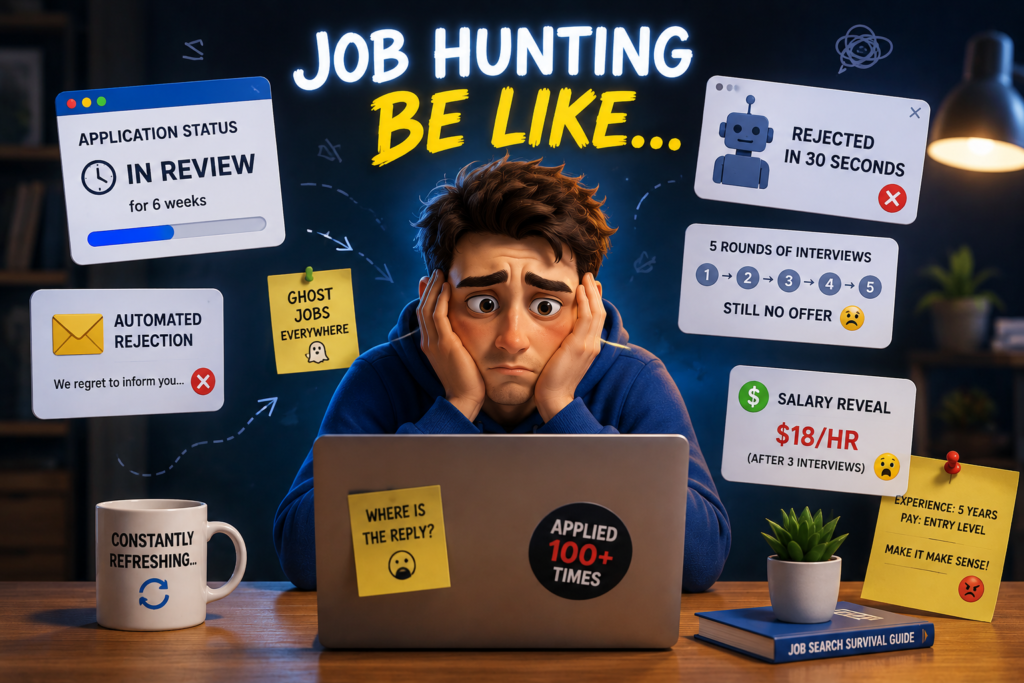
Why is the job application meme everywhere in 2026? Ghosting, AI rejections, and endless interviews explained—plus real fixes. Learn more inside
The Job Application Meme: Why It’s Taken Over the Internet (And What It Says About the Job Market)
If you’ve spent any time on LinkedIn, TikTok, or X in the past two years, you’ve seen it: a screenshot of an application status stuck on “In Review” for six weeks, a Shrek meme captioned “me refreshing my email for the 40th time today,” or the now-iconic “I have 15 years of experience but need entry-level pay” format. The job application meme has become its own genre of internet humor — and it’s not just comic relief. It’s a window into what job seekers are actually experiencing right now.
This article breaks down where the trend came from, the most popular formats, why they resonate so widely, and — since laughing about job hunting only gets you so far — practical next steps if you’re actually in the market for work.
Key Takeaways
• Job Application Memes can be seen as a coping mechanism that is meant to deal with the frustrating experience of being ignored, automatically rejected, and facing a number of final round interviews.
• Some of the most popular memes are related to black holes of application, automated rejection emails, and overqualification and underpayment.
• In addition, the meme on the topic of the job application can serve as a signal regarding the state of the job market, as some kinds of memes become especially widespread in correlation with the real slow-downs in the recruiting process or popular industries.
• If the memes resonate with you, make sure to use your sense of humor to improve your CV and look for particular companies’ vacancies online, such as Walgreens careers.
• Full-time jobs near me can be found much more efficiently if combined with an employer application process.
Where the Job Application Meme Trend Came From
Memes about work aren’t new, but the job application meme specifically exploded alongside a few real shifts in hiring:
- Applicant Tracking Systems (ATS) went mainstream. Job seekers started noticing their applications vanishing into systems that auto-filtered resumes before a human ever saw them.
- “Ghost jobs” entered the public vocabulary. Postings that stay live for months without ever leading to a hire became common enough that people started joking about applying into the void.
- Layoff waves in tech and media (2022–2024) put a large, terminally-online, meme-literate workforce back on the job hunt simultaneously — a perfect storm for viral content.
- AI recruiting tools added a new layer of dark humor: candidates joking about being rejected by an algorithm in under 30 seconds.
The result is a meme category with real staying power, because the underlying frustration hasn’t gone away.
The Most Common Job Application Meme Formats
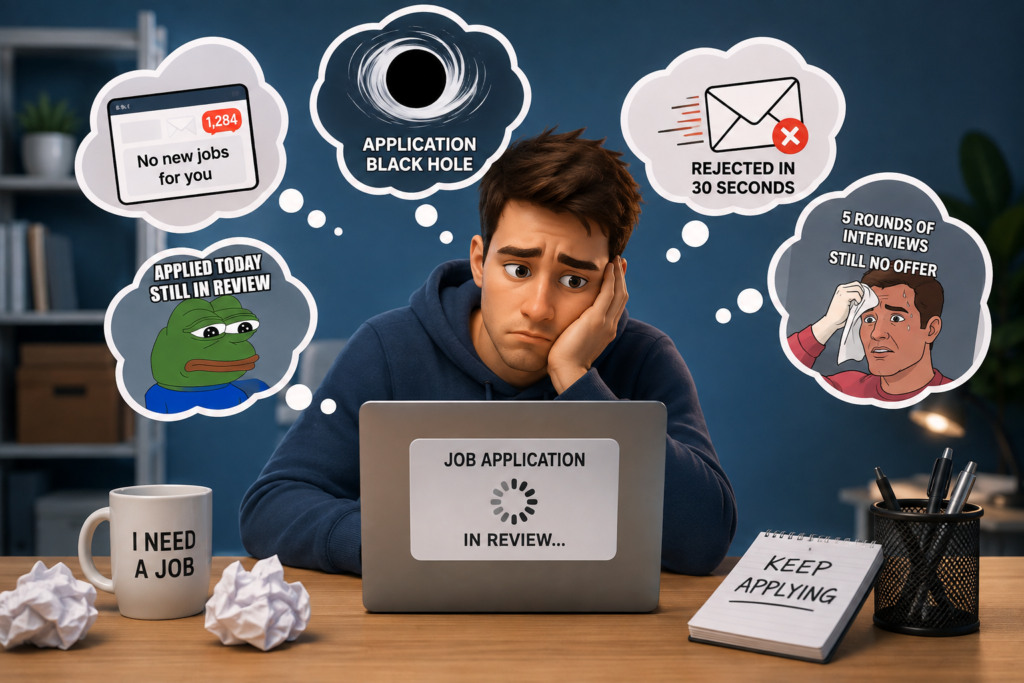
| Format | What It Captures | Example Caption Style |
| The Application Black Hole | Silence after submitting | “Applied 3 weeks ago. Status: still ‘Under Review.’ I’ve aged.” |
| The Overqualified Paradox | Needing experience for entry-level jobs | “Requires 5 years experience for an entry-level role. Cool, cool.” |
| AI Rejection Speedrun | Instant auto-rejections | “Rejected 12 minutes after applying. The bot didn’t even read it.” |
| The Endless Interview Loop | Five-plus rounds with no offer | “Round 6 of ‘let’s meet the team’ and still no salary discussion.” |
| Salary Reveal Whiplash | Job description hides pay until the final stage | “Sat through 3 interviews to find out the pay is $18/hr.” |
| The LinkedIn Humble-Brag Contrast | Mocking “I’m humbled to announce” posts next to real rejection stories | Self-explanatory contrast format |
Bolding the pattern here matters: nearly every viral job application meme format reflects a specific, repeatable pain point in the hiring process — not a vague complaint. That specificity is exactly why they’re so shareable; people don’t just relate, they feel seen.
Why These Memes Resonate So Widely
A few psychological and cultural reasons this format keeps performing well:
- Shared frustration reduces isolation. Job hunting is often a solitary, silent grind. Memes turn a private frustration into a public, communal joke.
- Humor as a coping mechanism. Research on workplace stress consistently shows that humor helps people process anxiety without escalating it — memes let job seekers vent without a full breakdown in the comments section.
- They’re genuinely informative. A meme about a five-round interview process with no offer is also, functionally, a warning to other candidates about that employer or industry norm.
- They travel across platforms. The same format that starts on X gets reposted to LinkedIn (often with an ironic “professional” caption), then clipped into a TikTok voiceover — extending its life cycle far beyond a typical post.
What the Memes Reveal About the Real Job Market
Treat the meme trend as a rough sentiment indicator, not hard data, but the correlation is worth noting:
- Spikes in “ghost job” memes tend to align with reports of postings staying open 60+ days without a hire.
- Increased “AI rejected me instantly” content tracks with the broader adoption of automated resume screening across mid-size and large employers.
- “Overqualified for entry level” jokes surge during periods when experienced workers, laid off from higher-paying roles, compete for jobs typically filled by early-career candidates — a dynamic that’s been especially visible in tech, media, and marketing since 2023.
If a specific meme format suddenly feels very accurate to your own search, that’s often a sign the underlying market condition it’s mocking is currently real — which is a good cue to adjust strategy rather than just keep applying the same way.
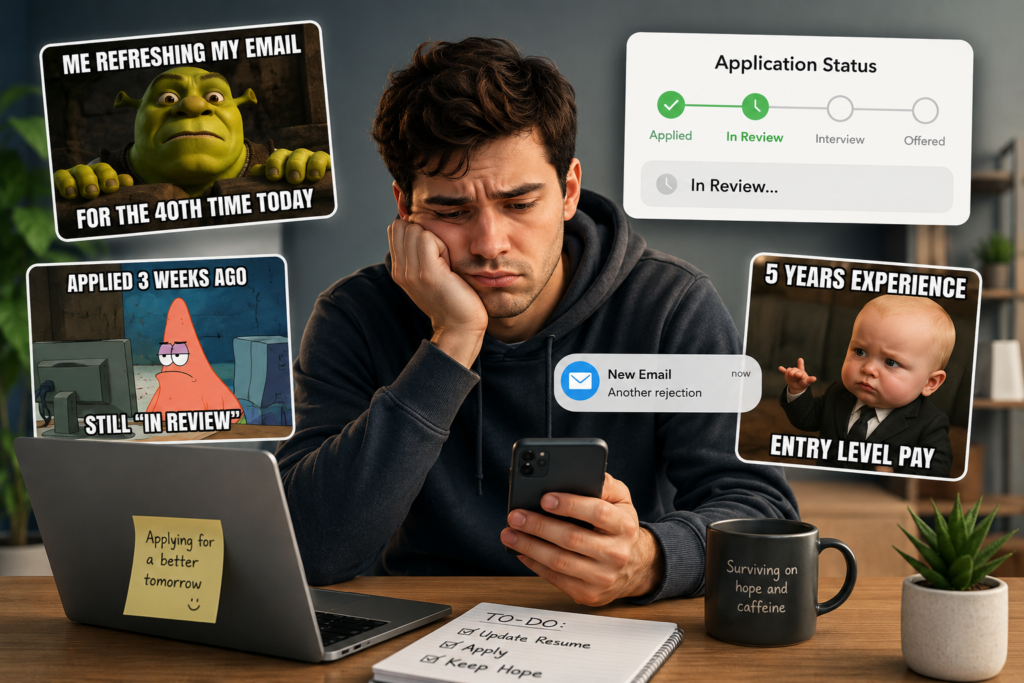
From Laughing About It to Actually Landing a Job
Memes are cathartic, but they’re not a strategy. If you’re actively searching, a few adjustments tend to outperform mass-applying into the void:
1. Narrow Your Search Instead of Widening It
Searching broadly for “jobs” or scrolling endless aggregator listings often produces the exact black-hole experience the memes joke about. A tighter search — for example, full-time jobs near me filtered by industry, commute radius, and posting recency — surfaces roles that are actually active and local, not reposted listings sitting stale for months.
2. Apply Directly on Employer Career Pages When Possible
Aggregators can be used for job search, but the application submitted directly via career portal of an organization is often routed differently from those submitted using the feed from an aggregator, and sometimes gets to the recruiter sooner. For instance, if your area of interest is retail, pharmacy, or corporate jobs at a major retail chain, then applying for a position on the career portal of Walgreens can be a better way to filter by location, department, and type of work schedule.
3. Treat Your Resume Like an ATS Has to Read It First
Given the prevalence of automated screening nowadays, your resume should:
• Contain the precise keywords from the job ad (no variations)
• Stay away from complex formatting (graphics, columns, tables that cannot be scanned by the ATS software)
• Open with results, not responsibilities
4. Track Applications Like a Spreadsheet, Not a Feeling
Job seekers who log company, date applied, status, and follow-up date consistently report less of the “black hole” anxiety — because they can see patterns (which companies respond, which don’t) instead of just feeling ignored.
5. Use the Humor, Don’t Live in It
It’s fine — healthy, even — to laugh at a meme that nails your exact experience. Just don’t let venting replace action. Set a weekly cap on scrolling meme content and a weekly floor on actual applications and follow-ups.
Comparing Where to Actually Look for Work
| Source | Best For | Watch Out For |
| Company career pages (e.g., Walgreens jobs) | Direct applications, accurate openings | Requires visiting each site individually |
| Job aggregator sites | Broad discovery, comparing many roles at once | Higher chance of stale or ghost listings |
| Networking, warm introductions, recruiter visibility | Easy to over-rely on “Easy Apply” with low response rates | |
| Local job boards / classifieds | Full-time jobs near me, smaller local employers | Less filtering/search sophistication |
| Referrals | Highest response and interview rate overall | Requires an existing network |
FAQ: Job Application Memes and the Modern Job Hunt
Why are job application memes so popular right now?
Because they capture very specific, widely shared frustrations — ghosting, instant AI rejections, and endless interview loops — that most job seekers have personally experienced in the last few years.
Do job application memes actually reflect the real job market?
To a degree, yes. Spikes in certain formats (like “ghost job” jokes or “rejected by a bot” content) often correlate with real trends in hiring practices, such as increased use of automated screening tools.
Is it bad that I relate so much to these memes?
No — relating to them is normal and, for many people, a healthy way to process job search stress. The key is making sure the humor doesn’t replace actual follow-through on applications and networking.
What’s a better alternative to mass-applying online?
Limiting your job search (by specifying criteria for filtering, such as full-time jobs near me in a certain industry that have posted recently), along with applying directly on a company career page (such as Walgreens jobs), is more likely to lead to more successful results.
Why do so many entry-level jobs ask for years of experience?
This is a classic case of disparity in job description format and job requirements as the posting is copied from a senior position template or due to employers’ desire to filter the applicants instead of the genuine need for such an experience level. It is one of the most popularly parodied formats on job application memes.
How do I know if a job listing is a “ghost job”?
Warning signs include a posting that’s been live for 60+ days, vague or shifting requirements, no named hiring manager, and an application process that yields no response even after multiple follow-ups.