
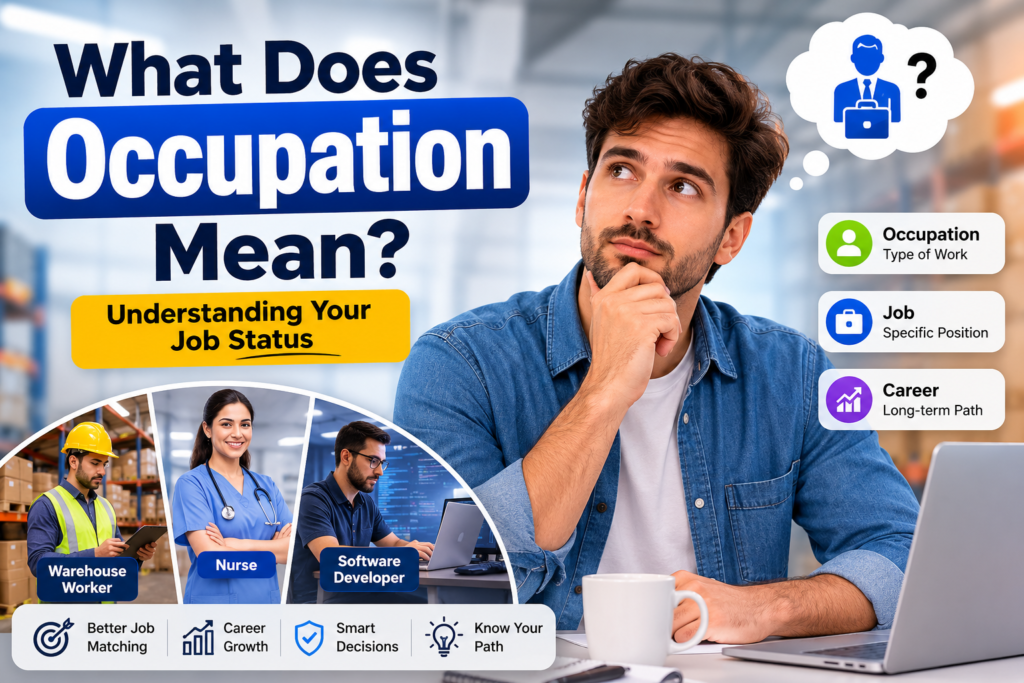
What does occupation mean vs job? Learn why occupation means job, how occupation, job, and career differ, why forms ask for it, and how to find your category. Learn more inside.
What Does “Occupation” Mean? A Complete Guide to Understanding Your Job Status
Key Takeaways
• The occupation means the kind of work that you do, that is, the nature of the job or profession that you practice without being concerned about the organization or place where you are doing your job.
• This is not the same as the job (your position in a certain organization) and career (the journey that you have followed in your profession across various jobs).
• The forms, application forms, and governmental forms will ask you to mention your occupation to understand what you do rather than where you do.
• Are you in search of jobs now? It will help you identify suitable jobs for you, including popular occupations like the occupation in warehousing and logistics.
• Prepared to do something about this? Read the upcoming parts that talk about warehouse jobs near me and Amazon hiring near me.
Occupation, Job, and Career: Why the Difference Actually Matters
People use these three words interchangeably in everyday conversation, but they mean distinct things — and knowing the difference can actually change how you approach your next move.
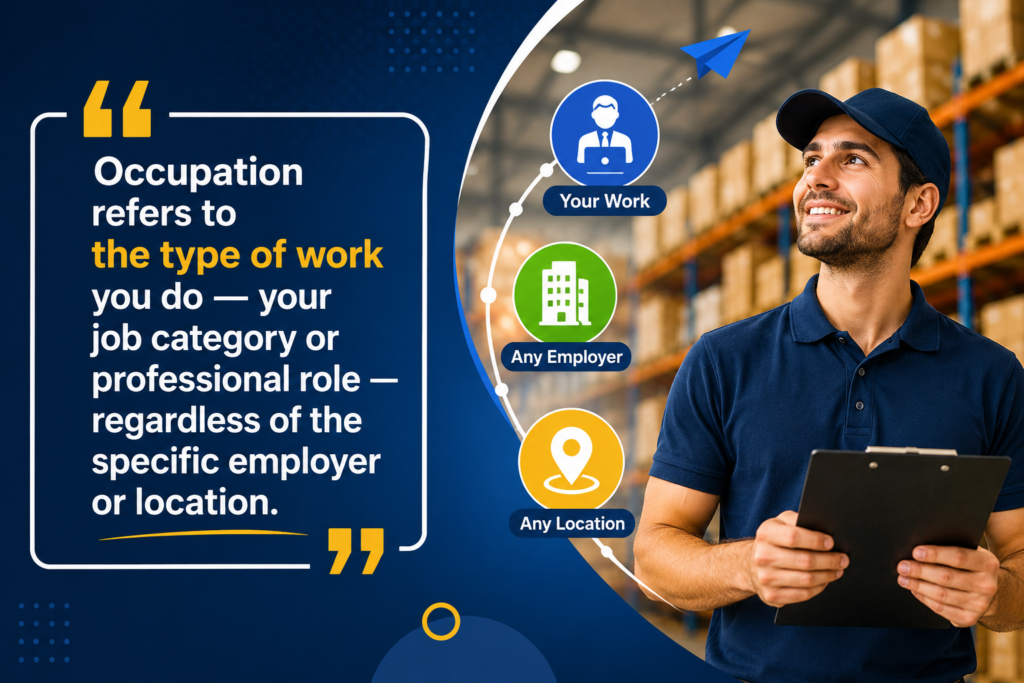
Occupation is the category of work. Think “warehouse associate,” “registered nurse,” or “software developer.” It’s a classification, not a specific employer relationship. The U.S. Bureau of Labor Statistics and the Standard Occupational Classification (SOC) system use this exact concept to group millions of workers into roughly 800 standardized categories, regardless of who signs their paycheck.
Job, on the other hand, is the specific position you hold. You might have the occupation of “warehouse associate,” but your job is “Fulfillment Center Associate at a specific Amazon facility in your city.” Same occupation, different job, if you switch employers.
Career is the broader arc — the sequence of jobs and occupations you move through over your working life, often within a related field or with an upward trajectory.
Here’s a simple table to make it click:
| Term | Definition | Example |
| Occupation | Category or type of work | Warehouse Worker |
| Job | Specific position at a specific employer | Picker/Packer at a distribution center |
| Career | Long-term professional path | 10 years progressing from associate to warehouse operations manager |
This distinction isn’t just semantic. When you fill out a loan application, a census form, or a job board profile, they’re usually asking for your occupation — the general lane you work in — because it tells them something predictive about your income, skill set, and stability, even before you name a specific employer.
Why Occupation Classification Matters for Your Job Search
Knowing your occupation is more than just interesting – there are many practical applications of this knowledge:
• Resumes: Recruitment services and automated applicant tracking systems tend to first screen for occupation-specific terms before even looking into the actual job titles you have listed on your resume.
• Pay information: Websites and government statistics (such as Bureau of Labor Statistics occupational wage reports) organize salary data not by individual jobs but by occupation, so you need to know yours in order to find the right data.
• Career transitions: In case of career shift from one industry to another, your occupation (i.e. “logistics coordinator”) is more likely to be transferable, as your skills are important to the employer rather than the title.
• Government and legal applications: Immigration forms, tax documents and unemployment claims all require an occupation field, which is usually standardized.
How to Identify Your Own Occupation Category
If you have problems figuring out which category your work falls into, consider asking yourself these three questions:
• What do I actually do on a daily basis? (This is not your job title – these are your actual tasks.)
• To what field or function does my work belong? (Logistics, health care, sales, trades, etc.)
• Does my bundle of tasks correspond to any standard job title? Most governmental classification systems have a database that allows you to type in your duties and receive an occupation code.
For example, someone who “moves inventory, operates a scanner, and loads trucks” would typically be classified under the broader occupation of material moving worker or warehouse and storage worker, even if their actual job title is something branded like “fulfillment associate.”
Choosing the Right Occupation Path: What to Weigh
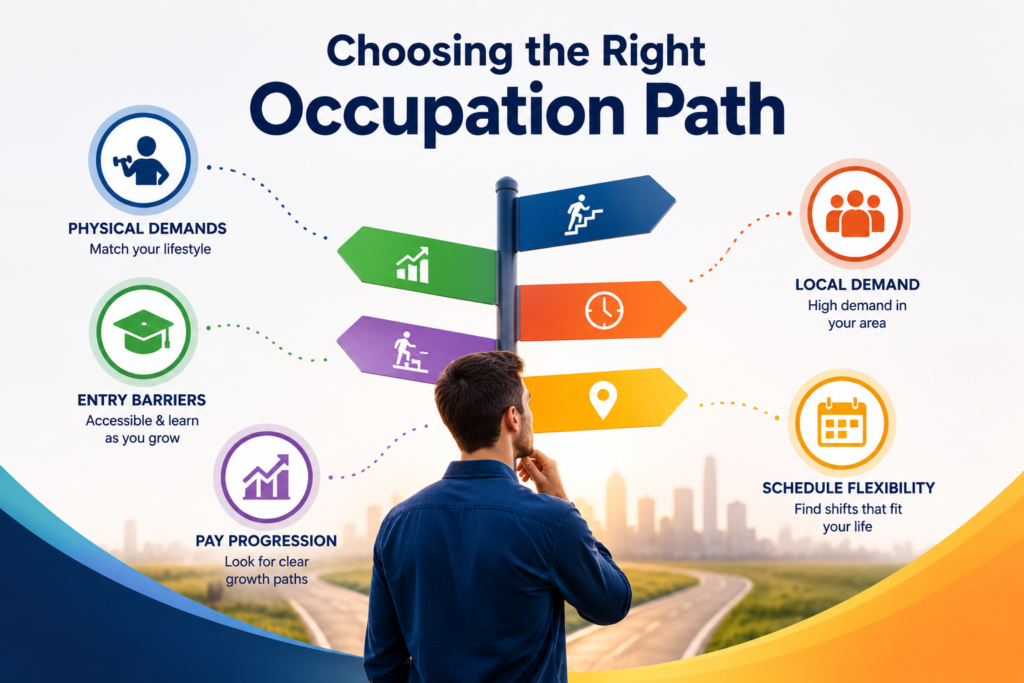
In case you are looking at an occupation that suits you best, there are a few points that make the difference between a satisfying choice and an annoying one:
• Physical requirements versus your life style – some occupations (such as warehouse and delivery jobs) are more physical and active than others.
• Barriers to entry – many logistics and warehouse occupations do not require any degree and provide paid training programs, which makes them easier to enter than other occupations.
• Career ladder – find out if the occupation has career progression (from associate to lead to supervisor to manager) or lacks one.
• Geographical demand – there are some occupations that are needed more in certain geographical areas because of proximity to logistics centers, hospitals, or factories.
• Work schedule – shift-based occupations such as warehouse, retail, and delivery offer more flexible working schedules than typical 9 to 5 occupations.
This is where the practical, job-hunting side of things comes in. Warehouse and logistics work has become one of the most consistently accessible occupation categories for people entering or re-entering the workforce, largely because of steady e-commerce demand and comparatively low entry requirements.
Turning This Into Action: Finding Real Openings
Understanding the occupation category is useful, but at some point you need actual openings. If you’re specifically looking at warehouse jobs near me, a few practical steps help you move faster than a generic search:
- Use location filters on job boards rather than broad searches — proximity affects commute cost and shift feasibility more than people expect.
- Check for same-day or next-day interview postings, which are common in high-volume warehouse hiring.
- Compare shift differentials — overnight and weekend warehouse shifts frequently pay more per hour than standard daytime shifts.
- Look for postings that specify paid training, since that lowers your effective barrier to entry.
Among large employers, Amazon hiring near me searches consistently surface some of the highest volume of warehouse and fulfillment openings, since the company runs continuous hiring cycles across its fulfillment and delivery network. If you go this route, applying directly through the official hiring hub tends to be faster and more reliable than third-party aggregator listings, since it reflects live openings by facility and shift.
Quick Comparison: Warehouse Occupation vs. Other Entry-Level Paths
| Factor | Warehouse/Logistics | Retail | Food Service |
| Typical entry requirement | No degree, paid training common | No degree | No degree |
| Physical demand | High | Moderate | Moderate to high |
| Shift flexibility | High (multiple shift options) | Moderate | High |
| Pay progression | Clear tiers common | Slower | Variable |
| Local demand | Strong near distribution hubs | Steady | Steady |
FAQ: Common Questions About Occupation and Job Search
What does “occupation” mean on a job application?
It means the general category or type of work you do — not the exact company or job title. Employers and forms use it to quickly understand your skill set and work history at a glance.
Is occupation the same as job title?
Not quite. Job title is specific to your employer (e.g., “Warehouse Associate II”), while occupation is the broader standardized category that job title falls under (e.g., “material moving worker”).
How do I find warehouse jobs near me quickly?
Use location-filtered searches on major job boards, set alerts for your zip code, and check company career pages directly for real-time openings, since these tend to update faster than aggregator sites.
Does Amazon hire for warehouse jobs near me year-round?
Amazon runs hiring cycles continuously across its fulfillment network, with additional surges during peak shopping seasons. Checking the official hiring hub for your area gives the most accurate, up-to-date openings.
What occupation should I choose if I have no experience?
Occupations with structured, paid training — like warehouse, logistics, and customer service roles — are generally the most accessible entry points, since they don’t require prior credentials.
Can my occupation change without changing my job?
Occupation classification is tied to the tasks you perform, so if your role’s core duties shift significantly (through a promotion or reassignment), your occupation classification can change even at the same employer.