JOB RISES

Uncategorized

Retail Associate

Retail Associate Jobs: 5 Things to Know (2026)

Thinking about becoming a retail associate? See real pay ranges, required skills, and how to find retail jobs near you today — discover how here. What Does a Retail Associate Actually Do? A Complete Career Guide If you have asked yourself questions regarding how to succeed as a retail associate, you may have put forward a better query compared to those posed by the majority of candidates. There are a lot of myths about the position, which can be placed in an undefined catch-all of “customer service,” “sales,” or “cashier.” It is important to learn about the truth behind it, which will allow you not only to land a job, but make a career out of it. In this guide, we provide you with a detailed breakdown of the position, as well as compare your alternatives in the market. Key Takeaways What Is a Retail Associate, Exactly? The role of the retail associate is that of the person who ensures that everything is going on smoothly in the retail store by providing customer assistance, replenishing stock, managing purchases, and making the customers feel that they are dealing with the right brand in every way possible. There can be variations in the name of the position across organizations, but the role remains the same. Core Responsibilities Most retail associate roles include some combination of the following: Responsibility What It Looks Like Day-to-Day Customer service Greeting shoppers, answering questions, resolving complaints Sales support Recommending products, upselling, meeting sales targets Cash handling Operating registers, processing returns and exchanges Merchandising Stocking shelves, building displays, maintaining store layout Inventory management Receiving shipments, cycle counts, reporting shrinkage Loss prevention Watching for theft, following security protocols Not every associate does all of these. A big-box store might split roles into specialists (cashier, stocker, department lead), while a boutique retailer expects one person to wear every hat. Skills That Actually Matter Hiring managers for retail jobs always mention that soft skills are sometimes more important than experience. This is what usually sets one candidate apart from the others. Technical skills can always be learned. Good attitude and reliability cannot be trained, which is why they usually appear at the beginning of the list. How Much Do Retail Associates Earn? Salary is very much dependent on the geographical location, size of the retail store and whether it is commission-based. In general terms, for the U.S. market: The benefits too differ from store to store. The larger chains usually provide health coverage, discount program and even help for your education costs (tuition reimbursement), but only after achieving a certain threshold of worked hours. Comparing Your Options: Types of Retail Jobs When people search for jobs in the retail sector, they’re often unaware of how different the experience can be depending on the format. Here’s a quick comparison: Retail Type Pace Typical Schedule Growth Potential Big-box / department stores Fast, high-volume Rotating shifts, weekends required Structured promotion tracks Specialty / boutique retail Moderate, relationship-driven More flexible Slower but skill-focused Grocery / convenience Fast, repetitive Early mornings, late nights Steady, less glamorous Luxury retail Slower, high-touch Predictable, client-based High commission ceiling E-commerce fulfillment/retail hybrid Warehouse-adjacent Fixed shifts Growing fast, less customer-facing If long-term advancement matters to you, big-box retailers and luxury brands tend to have the clearest internal promotion structures. If flexibility matters more, specialty and boutique retail usually win. Finding Retail Jobs Near You After figuring out what kind of retail environment works for you, the process of finding the right job comes to just a few actions: Where Industry Standards Come From In case you need to find out about the policy-making process in retailing, including work force policies and labor standards within the retail industry, then you need to become familiar with the Retail Industry Leaders Association (RILA). RILA is an association that advocates the interests of leading retailers on matters such as logistics, workforce development, and public policy. Its research can be of much help for those who want to find out what the future holds. FAQ What qualifications do I need to become a retail associate? Generally, most entry-level jobs require applicants to have a high school diploma at most, although specialty retail (electronics, high-end products) may need some experience with the particular merchandise. Is retail a good starting career? It is for many people. It helps develop transferable skills such as communication, sales, and conflict management and gives a practical approach to becoming a manager within a few years’ time. How many hours do retail associates typically work? It depends, ranging from 10-15 hours per week in case of part-time jobs to 35-40 hours per week in case of full-time jobs. Extra working hours may be required during holiday periods. Do retail associates get benefits? Large retailers usually provide health care benefits, discounts, and retirement plans for employees meeting certain minimum working hours; however, small retailers might not provide any formal benefit packages at all. What’s the difference between a retail associate and a sales associate? There may be some crossover in titles, however “sales associate” suggests the existence of more commission or quota emphasis, whereas “retail associate” refers to a wider scope of responsibility. How do I move from retail associate to management? Performance consistency, reliability, and showing interest to your manager are the most common ways. A number of retailers even provide internal leadership development programs for top performers.

Retail Associate Jobs: 5 Things to Know (2026) Read More »

How to Quit a Job

How to Quit a Job: 6 Steps to Resign Right

Not sure how to quit a job without burning bridges? A step-by-step breakdown of notice periods, resignation letters, and exit etiquette. Learn more inside. How to Quit a Job the Right Way: A Complete Guide to Resigning Gracefully It is not always as easy as just saying that “I quit.” If poorly done, it can end up burning bridges, putting your references in danger, and may even have an impact on your final paycheck. But if done right, it will not only ensure your good reputation but also will help you prepare for your future endeavors. This guide covers all of the steps you need to take in order to quit a job properly. Key Takeaways Why How You Quit Matters More Than You Think However, recruiters and hiring managers still talk to one another especially when they belong to the same industry. If you depart from a company in such a manner that you end up ghosting people at work, bad mouthing the company and causing a mess in the process, then you may have to face the consequences later on. On the contrary, you resign in such a way that your former boss becomes your future reference, maybe even employer. Step 1: Confirm You’re Ready to Go Before writing any sort of letter of resignation, be sure that resigning is really the correct decision. Be sure that you’ve asked yourself the following questions. If you have already been considering your other options, you can easily compare different jobs through websites such as Indeed where one can search indeed jobs near me. Step 2: Review Your Contract and Company Policy Check your offer letter or employee handbook for: Item Why It Matters Notice period Some contracts require 30 days, not two weeks Non-compete or non-solicit clauses Can restrict your next move Unused PTO payout rules Varies by state and company Benefits end date Affects health insurance timing Skipping this step is one of the most common regrets people report after resigning — don’t find out about a forfeited bonus after the fact. Step 3: Time Your Resignation Strategically Step 4: Have the Conversation First Do not give the notice in the form of an email, through Slack, or just around the office. Instead, request a private meeting and behave in as brief and professional a manner as possible. This is how: “I am writing to notify you of my resignation from my position, effective [date]. I have enjoyed my time with the firm and hope for a smooth transition.” There is no need to explain further, nor is it appropriate to rant. That will come later at the exit interview. Step 5: Write a Clear, Professional Resignation Letter Keep it short – three to four sentences will do. Make sure to: Don’t feel the need to give an explanation or justification for your decision. Step 6: Finish Strong Your last two weeks shape how you’re remembered. Aim to: Where This Fits Into Your Bigger Career Move Leaving is not always the end result but often just the first step toward something much better. Should your next venture involve a career in the government sector, then the USAJobs.gov website is the direct link that you can use for obtaining information on all aspects concerning such jobs. For private sector employment opportunities, getting a diverse portfolio of applications on several job websites will prove more fruitful. Frequently Asked Questions How much notice should I give when quitting a job? Two weeks is the standard in most U.S. workplaces, though some contracts or senior roles require 30 days. Always check your offer letter first. Can I quit a job without another one lined up? Yes, but it’s financially riskier. Most career advisors recommend having three to six months of expenses saved, or at least a solid search already underway, before resigning without a backup plan. Do I have to give a reason for quitting? No. A simple, polite statement that you’re resigning effective a certain date is sufficient — you’re not obligated to explain your reasoning to your employer. Is it better to quit in person or by email? In person or via video call is strongly preferred, followed by a written resignation letter for the record. Email-only resignations can come across as abrupt, especially in close-knit teams. Will I get paid for unused vacation days when I quit? This depends on your state and company policy. Some states legally require payout of accrued, unused PTO; others leave it up to company discretion, so check your handbook. What if my employer asks me to leave immediately instead of working my notice? This does happen, particularly in sensitive or competitive roles. It’s generally not personal — it’s a business decision, and in most cases you’re still paid through your notice period even if you’re asked not to work it.

How to Quit a Job: 6 Steps to Resign Right Read More »

Occupation Means Job

Occupation Means Job: What’s the Difference? (2026)

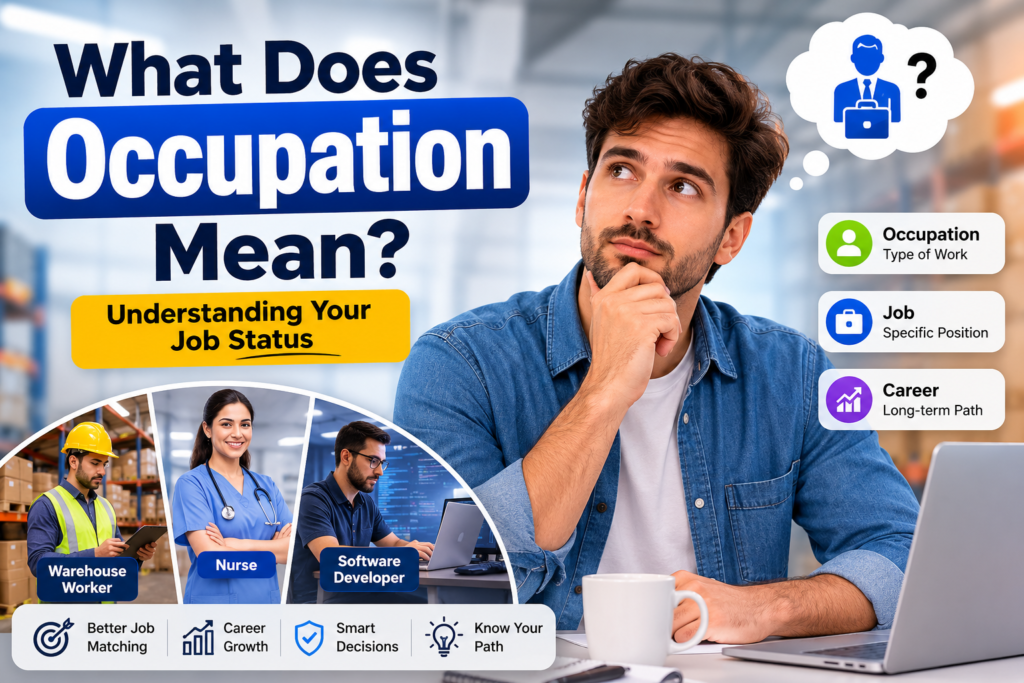
What does occupation mean vs job? Learn why occupation means job, how occupation, job, and career differ, why forms ask for it, and how to find your category. Learn more inside. What Does “Occupation” Mean? A Complete Guide to Understanding Your Job Status Key Takeaways •              The occupation means the kind of work that you do, that is, the nature of the job or profession that you practice without being concerned about the organization or place where you are doing your job. •              This is not the same as the job (your position in a certain organization) and career (the journey that you have followed in your profession across various jobs). •              The forms, application forms, and governmental forms will ask you to mention your occupation to understand what you do rather than where you do. •              Are you in search of jobs now? It will help you identify suitable jobs for you, including popular occupations like the occupation in warehousing and logistics. •              Prepared to do something about this? Read the upcoming parts that talk about warehouse jobs near me and Amazon hiring near me. Occupation, Job, and Career: Why the Difference Actually Matters People use these three words interchangeably in everyday conversation, but they mean distinct things — and knowing the difference can actually change how you approach your next move. Occupation is the category of work. Think “warehouse associate,” “registered nurse,” or “software developer.” It’s a classification, not a specific employer relationship. The U.S. Bureau of Labor Statistics and the Standard Occupational Classification (SOC) system use this exact concept to group millions of workers into roughly 800 standardized categories, regardless of who signs their paycheck. Job, on the other hand, is the specific position you hold. You might have the occupation of “warehouse associate,” but your job is “Fulfillment Center Associate at a specific Amazon facility in your city.” Same occupation, different job, if you switch employers. Career is the broader arc — the sequence of jobs and occupations you move through over your working life, often within a related field or with an upward trajectory. Here’s a simple table to make it click: Term Definition Example Occupation Category or type of work Warehouse Worker Job Specific position at a specific employer Picker/Packer at a distribution center Career Long-term professional path 10 years progressing from associate to warehouse operations manager This distinction isn’t just semantic. When you fill out a loan application, a census form, or a job board profile, they’re usually asking for your occupation — the general lane you work in — because it tells them something predictive about your income, skill set, and stability, even before you name a specific employer. Why Occupation Classification Matters for Your Job Search Knowing your occupation is more than just interesting – there are many practical applications of this knowledge: • Resumes: Recruitment services and automated applicant tracking systems tend to first screen for occupation-specific terms before even looking into the actual job titles you have listed on your resume. • Pay information: Websites and government statistics (such as Bureau of Labor Statistics occupational wage reports) organize salary data not by individual jobs but by occupation, so you need to know yours in order to find the right data. • Career transitions: In case of career shift from one industry to another, your occupation (i.e. “logistics coordinator”) is more likely to be transferable, as your skills are important to the employer rather than the title. • Government and legal applications: Immigration forms, tax documents and unemployment claims all require an occupation field, which is usually standardized. How to Identify Your Own Occupation Category If you have problems figuring out which category your work falls into, consider asking yourself these three questions: • What do I actually do on a daily basis? (This is not your job title – these are your actual tasks.) • To what field or function does my work belong? (Logistics, health care, sales, trades, etc.) • Does my bundle of tasks correspond to any standard job title? Most governmental classification systems have a database that allows you to type in your duties and receive an occupation code. For example, someone who “moves inventory, operates a scanner, and loads trucks” would typically be classified under the broader occupation of material moving worker or warehouse and storage worker, even if their actual job title is something branded like “fulfillment associate.” Choosing the Right Occupation Path: What to Weigh In case you are looking at an occupation that suits you best, there are a few points that make the difference between a satisfying choice and an annoying one: • Physical requirements versus your life style – some occupations (such as warehouse and delivery jobs) are more physical and active than others. • Barriers to entry – many logistics and warehouse occupations do not require any degree and provide paid training programs, which makes them easier to enter than other occupations. • Career ladder – find out if the occupation has career progression (from associate to lead to supervisor to manager) or lacks one. • Geographical demand – there are some occupations that are needed more in certain geographical areas because of proximity to logistics centers, hospitals, or factories. • Work schedule – shift-based occupations such as warehouse, retail, and delivery offer more flexible working schedules than typical 9 to 5 occupations. This is where the practical, job-hunting side of things comes in. Warehouse and logistics work has become one of the most consistently accessible occupation categories for people entering or re-entering the workforce, largely because of steady e-commerce demand and comparatively low entry requirements. Turning This Into Action: Finding Real Openings Understanding the occupation category is useful, but at some point you need actual openings. If you’re specifically looking at warehouse jobs near me, a few practical steps help you move faster than a generic search: Among large employers, Amazon hiring near me searches consistently surface some of the highest volume of warehouse and fulfillment openings,

Occupation Means Job: What’s the Difference? (2026) Read More »

Job Application Meme

Job Application Meme: Why It’s Everywhere in 2026

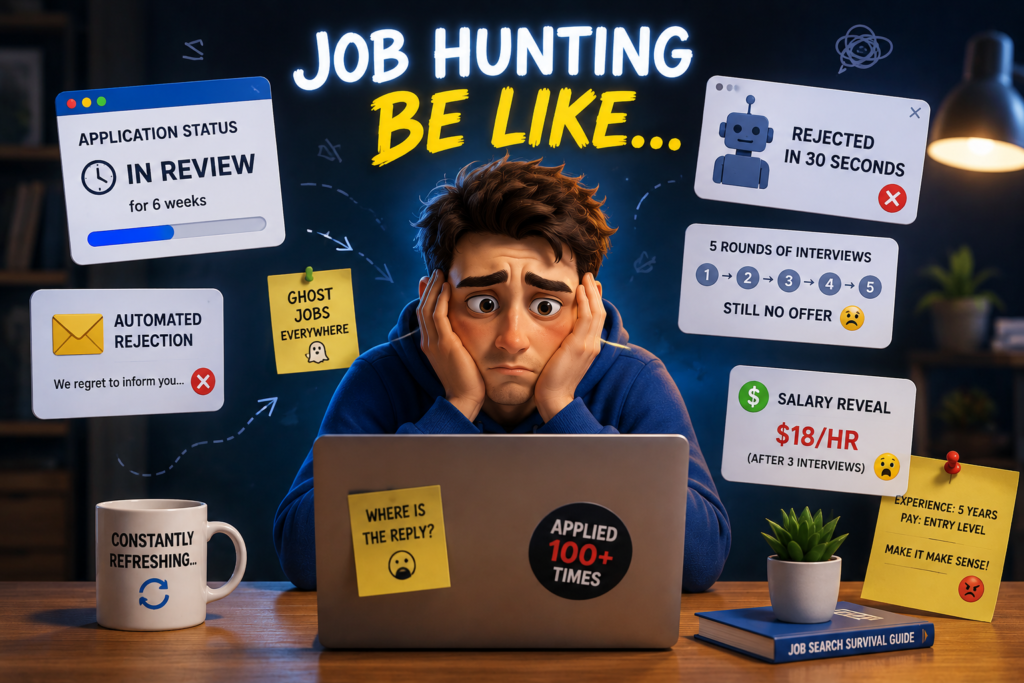
Why is the job application meme everywhere in 2026? Ghosting, AI rejections, and endless interviews explained—plus real fixes. Learn more inside The Job Application Meme: Why It’s Taken Over the Internet (And What It Says About the Job Market) If you’ve spent any time on LinkedIn, TikTok, or X in the past two years, you’ve seen it: a screenshot of an application status stuck on “In Review” for six weeks, a Shrek meme captioned “me refreshing my email for the 40th time today,” or the now-iconic “I have 15 years of experience but need entry-level pay” format. The job application meme has become its own genre of internet humor — and it’s not just comic relief. It’s a window into what job seekers are actually experiencing right now. This article breaks down where the trend came from, the most popular formats, why they resonate so widely, and — since laughing about job hunting only gets you so far — practical next steps if you’re actually in the market for work. Key Takeaways • Job Application Memes can be seen as a coping mechanism that is meant to deal with the frustrating experience of being ignored, automatically rejected, and facing a number of final round interviews. • Some of the most popular memes are related to black holes of application, automated rejection emails, and overqualification and underpayment. • In addition, the meme on the topic of the job application can serve as a signal regarding the state of the job market, as some kinds of memes become especially widespread in correlation with the real slow-downs in the recruiting process or popular industries. • If the memes resonate with you, make sure to use your sense of humor to improve your CV and look for particular companies’ vacancies online, such as Walgreens careers. • Full-time jobs near me can be found much more efficiently if combined with an employer application process. Where the Job Application Meme Trend Came From Memes about work aren’t new, but the job application meme specifically exploded alongside a few real shifts in hiring: The result is a meme category with real staying power, because the underlying frustration hasn’t gone away. The Most Common Job Application Meme Formats Format What It Captures Example Caption Style The Application Black Hole Silence after submitting “Applied 3 weeks ago. Status: still ‘Under Review.’ I’ve aged.” The Overqualified Paradox Needing experience for entry-level jobs “Requires 5 years experience for an entry-level role. Cool, cool.” AI Rejection Speedrun Instant auto-rejections “Rejected 12 minutes after applying. The bot didn’t even read it.” The Endless Interview Loop Five-plus rounds with no offer “Round 6 of ‘let’s meet the team’ and still no salary discussion.” Salary Reveal Whiplash Job description hides pay until the final stage “Sat through 3 interviews to find out the pay is $18/hr.” The LinkedIn Humble-Brag Contrast Mocking “I’m humbled to announce” posts next to real rejection stories Self-explanatory contrast format Bolding the pattern here matters: nearly every viral job application meme format reflects a specific, repeatable pain point in the hiring process — not a vague complaint. That specificity is exactly why they’re so shareable; people don’t just relate, they feel seen. Why These Memes Resonate So Widely A few psychological and cultural reasons this format keeps performing well: What the Memes Reveal About the Real Job Market Treat the meme trend as a rough sentiment indicator, not hard data, but the correlation is worth noting: If a specific meme format suddenly feels very accurate to your own search, that’s often a sign the underlying market condition it’s mocking is currently real — which is a good cue to adjust strategy rather than just keep applying the same way. From Laughing About It to Actually Landing a Job Memes are cathartic, but they’re not a strategy. If you’re actively searching, a few adjustments tend to outperform mass-applying into the void: 1. Narrow Your Search Instead of Widening It Searching broadly for “jobs” or scrolling endless aggregator listings often produces the exact black-hole experience the memes joke about. A tighter search — for example, full-time jobs near me filtered by industry, commute radius, and posting recency — surfaces roles that are actually active and local, not reposted listings sitting stale for months. 2. Apply Directly on Employer Career Pages When Possible Aggregators can be used for job search, but the application submitted directly via career portal of an organization is often routed differently from those submitted using the feed from an aggregator, and sometimes gets to the recruiter sooner. For instance, if your area of interest is retail, pharmacy, or corporate jobs at a major retail chain, then applying for a position on the career portal of Walgreens can be a better way to filter by location, department, and type of work schedule. 3. Treat Your Resume Like an ATS Has to Read It First Given the prevalence of automated screening nowadays, your resume should: • Contain the precise keywords from the job ad (no variations) • Stay away from complex formatting (graphics, columns, tables that cannot be scanned by the ATS software) • Open with results, not responsibilities 4. Track Applications Like a Spreadsheet, Not a Feeling Job seekers who log company, date applied, status, and follow-up date consistently report less of the “black hole” anxiety — because they can see patterns (which companies respond, which don’t) instead of just feeling ignored. 5. Use the Humor, Don’t Live in It It’s fine — healthy, even — to laugh at a meme that nails your exact experience. Just don’t let venting replace action. Set a weekly cap on scrolling meme content and a weekly floor on actual applications and follow-ups. Comparing Where to Actually Look for Work Source Best For Watch Out For Company career pages (e.g., Walgreens jobs) Direct applications, accurate openings Requires visiting each site individually Job aggregator sites Broad discovery, comparing many roles at once Higher chance of stale or ghost listings LinkedIn Networking, warm introductions, recruiter visibility

Job Application Meme: Why It’s Everywhere in 2026 Read More »

Great Job

What Makes a Great Job? Full Guide (2026)

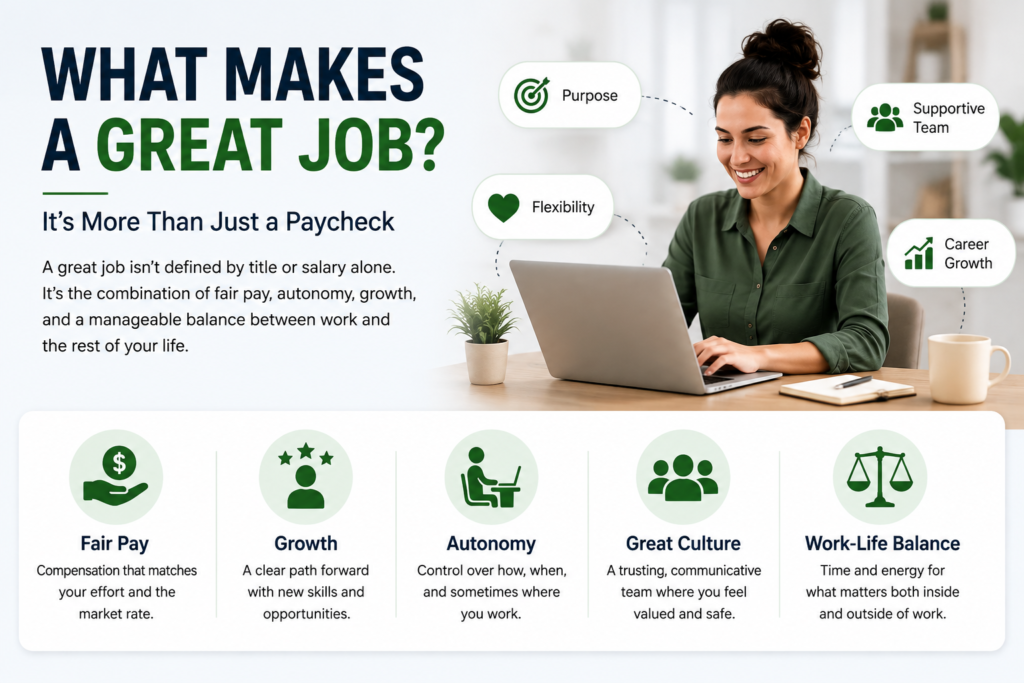
Searching for a great job? See what truly matters—fair pay, growth, and flexibility—plus how to actually land part-time remote roles. Find out now. What Makes a Great Job? A Real-World Guide to Finding Work You’ll Actually Love Most “great job” advice reads like it was written by someone who’s never had to choose between a longer commute and a better paycheck, or between flexibility and full benefits. This guide skips the platitudes. It breaks down what actually separates a great job from a job you tolerate, how part-time and remote roles fit into that picture, and how to go from “I need something better” to an actual offer letter. Key Takeaways What Does “A Great Job” Actually Mean? Ask ten people what makes a job great and you’ll get ten different answers — pay, flexibility, purpose, a good manager. Research on job satisfaction tends to converge on a smaller set of factors that show up again and again, regardless of industry: Notice that “prestige” and “big-name company” aren’t on that list. A great job is really a great fit — the right combination of these factors for where you are in your life right now. The Difference Between a Good Job and a Great Job Factor Good Job Great Job Pay Meets your basic needs Feels fair relative to your contribution and the market Schedule Fixed, little flexibility Predictable, with room to adjust when life happens Growth Occasional review, no clear path Regular feedback and a visible next step Culture Tolerable, low conflict Trusting, communicative, low turnover Control Told what and how to do things Given outcomes to hit, trusted with the “how” Doing a Great Job vs. Having a Great Job There’s a second meaning worth addressing directly: people also search this phrase wanting to know how to do great work — how to actually perform at a level that gets noticed, promoted, or referred. A few things tend to separate people who are seen as doing a great job from everyone else doing “fine”: Both meanings — a great job to work at, and doing a great job once you’re there — matter more together than either does alone. A great employer makes it easier to do great work; doing great work is also how you earn your way into a great job in the first place. The Rise of Part-Time Remote Jobs Part-time remote work was once considered a specialized work model. This is no longer the case. Remote work opportunities in the U.S. have increased threefold between 2020 and 2026, and flexible working conditions have evolved from being an additional benefit of employment that may or may not happen into an actual demand by workers. According to surveys of part-time remote workers, a significant percentage reports that they work more productively from home, which explains the reason for continuous growth of such positions among companies. However, all things aren’t so well in remote world as well – some companies have tightened their return to office policies in 2026, and remote only vacancies have become less available in some sectors. Thus, the conclusion is not that remote work is guaranteed but rather that part-time remote work is actually available. Who Part-Time Remote Jobs Actually Work For Pros and Cons of Part-Time Remote Work Pros Cons Control over hours and location Often no employer-sponsored health benefits No commute, more time flexibility Can feel isolating without deliberate effort to connect Easier to combine with caregiving, school, or a second job Income is lower and sometimes less predictable Access to jobs outside your immediate city More competition per posting than local, in-person roles Good testing ground for a career pivot Requires strong self-management and communication How to Actually Land a Part-Time Remote Job Finding “Part Time Jobs Near Me”: A Practical Local Search Strategy If your priority is in-person, hourly, or hybrid work close to home, the search behaves differently than a remote job hunt. A few things actually move the needle: Quick Comparison: Where to Search Search Method Best For Watch Out For General job boards (Indeed, ZipRecruiter) Broad local search, filtering by distance Outdated or duplicate listings Employer career pages directly Freshest openings, direct application Have to check each employer individually Walk-in / in-person inquiry Retail, food service, hourly roles Time-consuming, works best at specific hours Local Facebook groups / community boards Small businesses, gig work Less vetting, verify legitimacy yourself Staffing agencies Fast placement, temp-to-hire roles Sometimes lower pay than direct hire FAQ What actually makes a job “great” versus just “okay”? It comes down to fit — fair pay, real autonomy, a visible path to grow, and a workload you can sustain without burning out. A job can check every box on paper and still not be great if the day-to-day trust and communication aren’t there. Are part-time remote jobs harder to find than full-time remote jobs? Not necessarily harder, but they’re a smaller pool and often more competitive per listing, since they attract people juggling school, caregiving, or a second job. Casting a wider net across employer sites, not just aggregators, helps. How do I search for part-time jobs near me without wasting time on outdated listings? Combine a couple of job boards with direct employer career pages, and set alerts instead of manually refreshing. Local, hourly roles turn over fast, so alerts catch openings before they disappear. Do part-time jobs come with benefits? It varies widely by employer and by how many hours you’re scheduled. Some retailers and larger employers extend limited benefits — like paid time off or discounts — to part-time staff once you hit a certain hours threshold, so it’s worth asking directly during the interview. Is remote work becoming harder to find in 2026? It’s mixed. Some companies have pulled back with stricter return-to-office policies, while remote job postings overall remain far more common than they were before 2020. The safest approach is to treat remote roles as competitive but real, not as a long shot. What’s the fastest way

What Makes a Great Job? Full Guide (2026) Read More »